Why Chemistry Matters: The Foundation of Engineering a Sustainable Plating Line
Why Chemistry Matters: The Foundation of Engineering a Sustainable Plating Line
Choosing a plating line manufacturer that understands your chemistry can mean the difference between years of reliable production and years of costly problems.
By Plating International, Inc.
A Plating Line Is More Than Tanks and Equipment
When investing in a new plating line or upgrading an existing operation, manufacturers often focus on equipment costs, production capacity, automation, and installation timelines.
While these are important considerations, one critical factor is sometimes overlooked:
Does the company designing and manufacturing your plating line truly understand the chemistry that will be used in it?
At Plating International, Inc., we believe understanding the chemistry should be the starting point of every plating line project, not an afterthought.
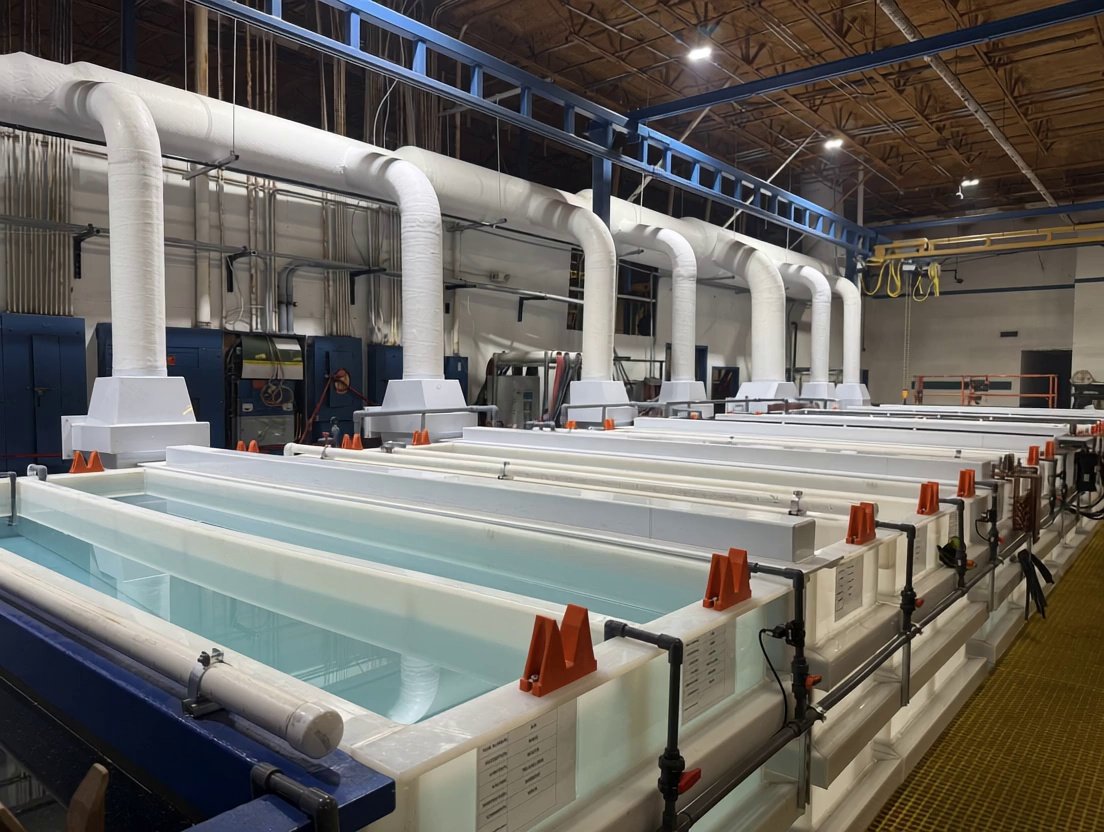
A plating line is not simply a collection of tanks, pumps, rectifiers, piping, and ventilation systems. It is an interconnected process where chemistry, temperature, electrical requirements, materials of construction, and operating conditions must work together.
When these elements are not properly evaluated, the consequences can be expensive.
The Hidden Cost of Choosing the Wrong Materials
Not all plating processes operate under the same conditions, and not all construction materials are compatible with every chemical solution.
Consider the differences between hard chrome plating, electroless nickel, anodizing, and various cleaning or pretreatment processes.
Each process presents unique challenges involving:
Chemical compatibility: Acids, alkaline solutions, oxidizers, and other process chemicals interact differently with construction materials.
Operating temperatures: A material that performs well at room temperature may not be suitable for elevated-temperature applications.
Electrical requirements: Rectifier capacity, copper bussing, and current distribution must be designed around the plating process.
Ventilation requirements: Proper capture and exhaust design depend on the chemistry, operating conditions, and potential emissions.
Maintenance and accessibility: Equipment should be designed for inspection, servicing, and long-term reliability.
Selecting the wrong tank lining, piping material, pump, or ventilation component can lead to premature deterioration, leaks, unexpected shutdowns, and expensive repairs.
The lowest initial equipment price does not always translate into the lowest long-term operating cost.
A plating line should be evaluated based on its total cost of ownership, not simply the price of construction.
Chemistry Knowledge Should Influence Every Design Decision
Imagine installing a new plating line only to discover that certain components cannot withstand the chemistry or operating temperatures. What initially appeared to be a cost-effective installation can quickly become a maintenance problem. This is why chemistry knowledge matters during the engineering and design process. Before recommending construction materials or equipment, a qualified plating line manufacturer should understand:
1. What chemistry will be used?
The exact chemical composition, concentration, and expected operating conditions help determine suitable materials.
2. What temperatures will the process operate at?
Continuous operating temperature, maximum temperature, and potential temperature fluctuations all influence material selection.
3. How will the process be controlled?
Chemical additions, filtration, agitation, heating, and electrical control should be considered during the initial design.
4. What are the long-term production requirements?
The line should accommodate anticipated workloads, maintenance requirements, and potential future expansion.
5. How will the equipment be maintained?
Access to pumps, piping, heaters, rectifiers, and other critical components should be incorporated into the design rather than addressed after installation.
Understanding these factors before construction begins can help eliminate problems that might otherwise follow a plating operation for years.
Sustainability Begins With Reliability
When discussing sustainability in surface finishing, conversations often focus on water consumption, chemical usage, wastewater treatment, and environmental compliance.
These are all essential.
However, another important aspect of sustainability is often overlooked:
How long can your plating line operate efficiently without unnecessary repairs, equipment replacement, or unplanned downtime?
A properly engineered plating line can contribute to sustainability by:
Extending the useful life of tanks, liners, pumps, and other equipment.
Reducing premature equipment replacement and associated material waste.
Helping prevent chemical leaks and unnecessary chemical losses.
Supporting efficient heating, electrical distribution, and process control.
Reducing maintenance-related production interruptions.
Making future upgrades and automation easier to implement.
Sustainability is not only about reducing environmental impact. It is also about building a production system that remains reliable, efficient, and economically viable over time.
A plating line that lasts longer, operates more consistently, and requires fewer unnecessary repairs is a more sustainable investment.
Designing for Today's Operation and Tomorrow's Growth
The surface finishing industry continues to evolve.
Automation, improved process monitoring, chemical feed systems, wastewater treatment technologies, and energy-efficient equipment are becoming increasingly important.
When designing a new plating line, manufacturers should consider more than today's production requirements.
Can the system accommodate future automation?
Can chemical additions be controlled more consistently?
Can maintenance personnel access critical equipment without disrupting production?
Can the operation expand without requiring major modifications to the original installation?
These questions are easier to address during the design phase than after the equipment is installed.
A manufacturer that understands both plating chemistry and equipment engineering can help customers evaluate these opportunities before construction begins.
Why Plating International Takes a Chemistry-First Approach
At Plating International, Inc., our experience in plating chemistry, equipment, and technical service provides an important perspective when evaluating plating line projects.
We understand that a successful plating operation depends on more than the equipment itself.
The chemistry determines many of the requirements that the equipment must meet.
Through our equipment manufacturing capabilities, including RK Fabrication, we can bring together process knowledge, material selection, engineering, fabrication, and installation support.
Our capabilities include plating tanks and liners, rectifiers, copper bussing, ventilation systems, pumps, heating equipment, automation, and complete plating line solutions.
Our approach is straightforward:
Understand the chemistry. Evaluate the operating conditions. Select the correct materials. Design for long-term reliability.
By considering these factors together, we aim to help customers avoid preventable equipment failures, improve operational efficiency, and protect their long-term investment.
The Right Manufacturer Can Make All the Difference
A new plating line is a significant investment, and the decisions made during its design can affect an operation for decades. Choosing a manufacturer based solely on equipment pricing or fabrication capabilities may overlook some of the most important factors affecting long-term performance. Before selecting your next plating line manufacturer, ask one important question:
Do they understand the chemistry that their equipment will be exposed to every day?
Because when it comes to plating line reliability, safety, and sustainability, chemistry matters.
Understanding the Chemistry. Engineering the Solution. Supporting Your Success.
Whether you are building a new plating line, upgrading existing equipment, or evaluating material compatibility, Plating International can help you make informed decisions for long-term performance.
Website: www.PlatingInternational.com
Email: Info@PlatingInternational.com
Phone: 847-451-2101